
A Croatian Voice from the Edge of the Empire: Discover the Language of the Burgenland Croats
When most of us think of the Croatian language, we picture the štokavian standard heard in Zagreb, Split or Dubrovnik. But there is another Croatian — older in its written form than modern standard Croatian, shaped by five centuries of life across borders, and still spoken today in pockets of Austria, Hungary, Slovakia and the Czech Republic.
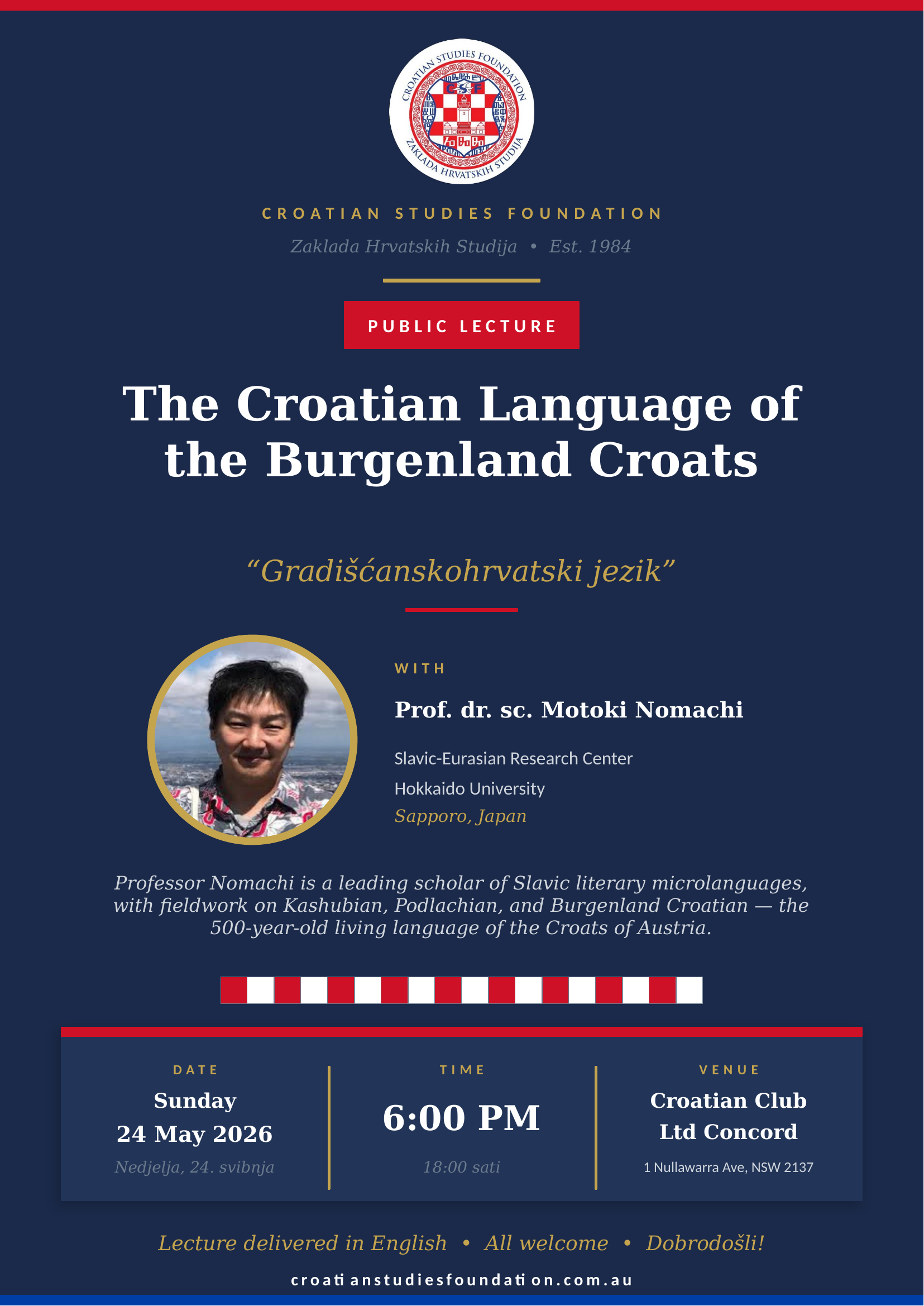
It is called gradišćanskohrvatski jezik — the language of the Burgenland Croats — and on Sunday, 24 May 2026, the Croatian Studies Foundation is bringing one of the world's leading scholars on Slavic micro-languages to Sydney to tell its remarkable story.
About the lecture
The Croatian Studies Foundation (Zaklada Hrvatskih Studija) is delighted to host:
The Croatian Language of the Burgenland Croats — Gradišćanskohrvatski jezik A public lecture by Prof. dr. sc. Motoki Nomachi Slavic-Eurasian Research Center, Hokkaido University, Sapporo, Japan
Date: Sunday, 24 May 2026
Time: 6:00 PM
Venue: Croatian Club Ltd Concord, 1 Nullawarra Ave, Concord NSW 2137
Language: Lecture delivered in English
Entry: Open to members, friends and the wider community
Who are the Burgenland Croats?
In the 16th century, as the Ottoman wars devastated parts of Lika, Krbava, Kordun, Banovina, Moslavina and western Bosnia, tens of thousands of Croats fled north. They were given land and ecclesiastical rights by the Habsburg King Ferdinand I and resettled depopulated villages in what is today eastern Austria, western Hungary, southern Slovakia and the southern Czech Republic.
Their descendants are the Gradišćanski Hrvati — the Burgenland Croats. Today there are still tens of thousands of speakers, and Burgenland Croatian holds co-official status in much of the Austrian state of Burgenland.
What makes their language so fascinating? While the Croats of the homeland built a unified standard language in the 19th century based largely on the štokavian dialect, the Burgenland Croats took a different path. Cut off from those reforms, they preserved and codified their own literary language — built mainly on the čakavian dialect, with traces of štokavian and kajkavian, and centuries of contact with German and Hungarian.
It is, in a very real sense, a parallel Croatian — a sister tradition that has weathered five centuries on the move.
Why this lecture matters
Professor Motoki Nomachi is one of the world's foremost specialists on Slavic micro-languages. Based in Sapporo at one of Japan's most respected research centres for Slavic and Eurasian studies, his fieldwork has taken him to Burgenland Croatian communities, as well as Kashubian speakers in Poland, Banat Bulgarians, Bunjevci in Serbia, and Gorani communities across the Balkans.
What he brings to Sydney is a perspective few audiences ever get: an outside scholar of extraordinary depth and care, looking at Croatian language and identity from the vantage point of a global comparativist. His work asks the questions that matter most for diaspora communities like ours:
How does a language survive far from its homeland?
How do communities codify, teach and pass on a written tradition under minority status?
What does Burgenland Croatian tell us about Croatian identity itself — its diversity, its resilience, its capacity to take root in new soil?
For Croatian Australians, these are not abstract questions. They are our questions.
Why you should come
This lecture is a rare opportunity to:
Hear from a world-class scholar whose work is published across Europe, North America and Asia
Discover a Croatian language tradition that most of us have never heard spoken
Connect the dots between the Burgenland diaspora's experience and our own Australian-Croatian story
Meet others in the Sydney community who share a love of Croatian language, culture and history
Support the CSF's mission of promoting Croatian studies in the Southern Hemisphere
The lecture is delivered in English and is open to everyone — members, friends, students, and anyone curious about Croatian language and heritage. Whether you're a linguist, a heritage speaker, a teacher, or simply someone who wants to understand more about where Croatian has travelled in the world, you will leave with something new.
Reserve your place
Seating is limited, so please RSVP as soon as you can.
🔗 Click here to RSVP for the CSF May 2026 Public Lecture
Dobro nam došli! We look forward to welcoming you at the Croatian Club Concord on Sunday, 24 May 2026.
Croatian Studies Foundation — Zaklada Hrvatskih Studija Sharing our love of Croatia, its culture and language since 1984. croatianstudiesfoundation.com.au